
The Marketing Automation Tools Powering High-Growth Brands
Growth brands usually do not need more campaigns. They need cleaner segmentation, faster handoffs, and automations that adapt to what customers actually do.
Quick Verdict
Best when sales, email, landing pages, and CRM records need to live in one system.
Best when Shopify or ecommerce behavior should trigger email and SMS flows.
Best for product-led teams that need event-based lifecycle messages.
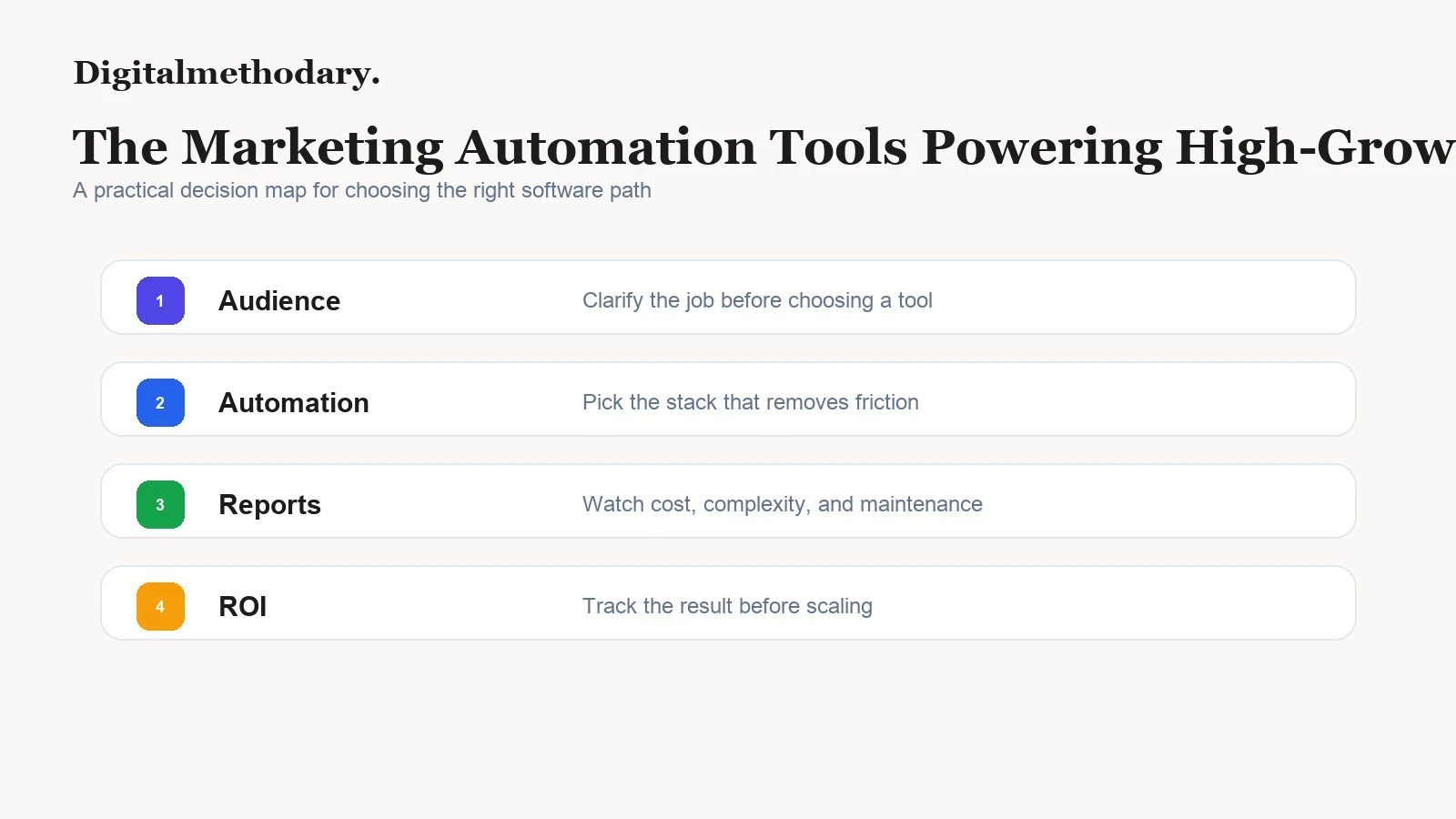
Specific Tool Shortlist
1. HubSpot
CRM-centered automation
HubSpot is strongest when marketing automation needs to connect directly to contacts, deals, forms, pages, and sales activity. It is often overkill for a simple newsletter but valuable when multiple teams touch the same lead.
Where it helps
- CRM, forms, email, landing pages, and reporting live together.
- Strong handoff from marketing to sales.
- Large integration ecosystem.
Tradeoffs
- Cost rises quickly as contacts, seats, and hubs expand.
- Advanced automation can push teams into higher tiers.
Pricing signal: Free tools exist, but serious automation often requires paid hubs.
2. Klaviyo
Ecommerce lifecycle engine
Klaviyo is the default shortlist tool for ecommerce brands that want abandoned cart, post-purchase, winback, and VIP flows tied to customer behavior.
Where it helps
- Deep ecommerce segmentation.
- Strong revenue attribution for email and SMS.
- Useful prebuilt flows for stores.
Tradeoffs
- Less natural for service businesses or B2B sales teams.
- Costs scale with list size and SMS usage.
Pricing signal: Pricing depends on contacts, email volume, and SMS usage.
3. Customer.io
Behavior-based product messaging
Customer.io is best when your automation depends on product events: trial started, feature used, account invited, plan upgraded, or risk of churn.
Where it helps
- Excellent for event-triggered lifecycle messaging.
- Flexible segmentation for SaaS products.
- Supports email, push, SMS, and in-app style workflows.
Tradeoffs
- Needs cleaner data plumbing than simpler email tools.
- Not the quickest path for non-technical teams.
Pricing signal: Team pricing depends on profiles and message volume.
Behind almost every fast-scaling company today is a quiet layer of marketing automation tools — systems that capture leads, segment audiences, trigger actions, and personalize experiences at scale. These tools rarely appear on the surface, but they determine whether growth compounds or stalls.
This article isn’t about what tools exist.
It’s about which tools high-growth brands actually rely on — and how they think about automation differently.
Why High-Growth Brands Think Differently About Automation
Most teams approach automation tactically:
send a welcome email, tag a subscriber, schedule a follow-up.
High-growth brands approach automation strategically.
For them, automation is not a feature — it’s infrastructure.
They use it to:
- Reduce dependency on individual marketers
- Turn one campaign into a repeatable system
- Personalize at scale without hiring more people
- Make customer journeys predictable and measurable
In other words, automation is how growth becomes durable, not fragile.
Automation Is No Longer Optional — It’s the Growth Baseline
In 2026, customer expectations are shaped by the best brands in the world.
That means instant responses, relevant messaging, and seamless handoffs between channels.
Manual marketing cannot meet those expectations.
That’s why modern teams build automation around:
- Behavior, not assumptions
- Triggers, not schedules
- Systems, not silos
The tools that enable this are not flashy — but they are powerful.
The Automation Stack High-Growth Brands Converge On
If you look closely at high-growth companies across SaaS, ecommerce, education, and B2B services, a pattern emerges. Their stacks differ in detail, but converge in function.
The Intelligence Layer: Knowing Who the User Is
High-growth brands obsess over context.
A platform like HubSpot becomes the backbone because it connects contacts, behavior, lifecycle stage, and revenue into a single system. Automation only works when you know who someone is and where they are in the journey.
This is why CRMs are no longer “sales tools”.
They are automation engines with memory.
The Messaging Layer: Automating Relevance, Not Spam
Email automation is where many teams fail — and where strong brands quietly outperform.
High-growth brands use platforms like ActiveCampaign, GetResponse, or ConvertKit not just to send emails, but to orchestrate conversations.
The difference is subtle but critical:
- Triggers based on behavior, not time
- Branching logic instead of linear sequences
- Segmentation that updates automatically
Automation here doesn’t feel automated.
It feels timely.
The Orchestration Layer: Connecting Everything Quietly
High-growth brands hate manual handoffs.
That’s where tools like Zapier quietly power operations behind the scenes — syncing leads, triggering workflows, updating records, and ensuring no action depends on human memory.
The real advantage isn’t speed.
It’s consistency.
When automation handles transitions between tools, teams stop losing opportunities in the gaps.
What High-Growth Brands Automate First (and Why)
Contrary to popular belief, they don’t start by automating everything.
They start where leverage is highest.
Typically:
- Lead capture → segmentation → follow-up
- Trial or signup onboarding
- Sales handoff qualification
- Customer re-engagement and retention
- Internal alerts and prioritization
These are moments where timing matters and volume grows faster than headcount.
Automation here doesn’t replace strategy — it protects it from scale.
The Real Difference: Automation as a Business Asset
Low-maturity teams see automation as:
- A way to save time
- A marketing convenience
- A campaign add-on
High-growth brands see automation as:
- A reusable asset
- A system that survives team changes
- A way to encode best practices
- A growth multiplier that compounds
This mindset shift explains why two companies using the same tools can have wildly different outcomes.
Why Tool Choice Still Matters
Mindset matters more — but tools still matter.
High-growth brands choose tools that:
- Scale without breaking
- Integrate deeply
- Offer visibility, not black boxes
- Support complexity without becoming fragile
That’s why they often outgrow basic tools quickly and invest earlier in platforms designed for systems, not just features.
The cost of switching later is always higher.
Automation Without Measurement Is Just Noise
Another pattern among high-growth teams:
automation is always tied to measurement.
Platforms like Google Analytics and CRM reporting dashboards aren’t afterthoughts — they’re feedback loops.
Automation is constantly:
- Tested
- Tuned
- Pruned
- Rebuilt
What doesn’t convert is removed.
What works is reinforced.
Automation is never “set and forget”.
It’s set, observe, refine.
The Quiet Advantage Most Teams Miss
The biggest advantage of marketing automation tools isn’t efficiency.
It’s decision clarity.
When systems handle execution, leaders can focus on:
- Positioning
- Strategy
- Market insight
- Channel prioritization
High-growth brands don’t ask:
“How do we send more emails?”
They ask:
“Which system produces the most qualified momentum?”
Automation gives them the space to ask better questions.
Final Thoughts: Automation Is What Separates Momentum from Luck
Growth driven by heroics eventually collapses.
Growth driven by systems compounds.
The marketing automation tools powering high-growth brands are not secrets — but the way they are used often is.
If there’s one takeaway, it’s this:
Successful brands don’t automate because they’re big.
They get big because they automated early — and intentionally.
Build systems that outlast campaigns, and marketing stops being stressful.
It becomes predictable.