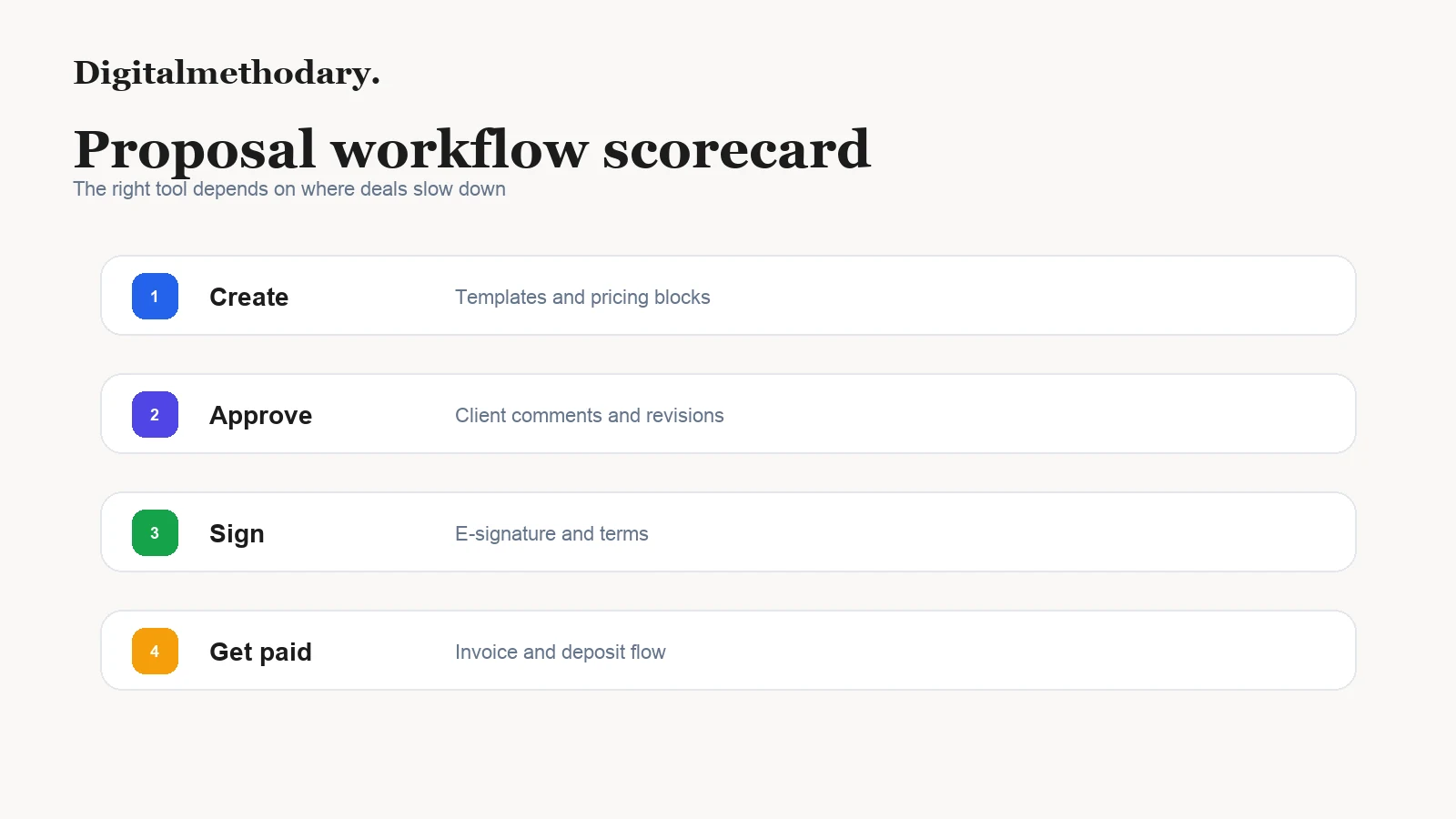
Best Proposal Software for Freelancers and Agencies
The best proposal software should do three things well: help you create a polished proposal fast, make pricing easy for clients to understand, and remove friction from the signature step. Freelancers need speed and simplicity. Agencies usually need approval workflows, reusable content, better tracking, and a cleaner handoff from sales to delivery. This roundup compares four strong options for both use cases: Proposify, Better Proposals, Qwilr, and PandaDoc.
If you want the short version, PandaDoc is the most balanced pick for most buyers, Qwilr is the best choice for design-led proposals that feel modern and interactive, Proposify is excellent for agencies with a more structured sales process, and Better Proposals is the easiest budget-conscious option for freelancers who want to get moving quickly.
Affiliate Disclosure
Digital Methodary may earn a commission if you sign up through a partner link or CTA in this article. That does not change the way products are evaluated here. The goal is simple: recommend tools that are genuinely useful, point out where they are weak, and help you avoid paying for software that does not fit the way you sell. Pricing in software changes often, so treat the dollar figures below as practical starting points, not permanent quotes.
Quick Picks
Best Overall: PandaDoc
PandaDoc is the safest recommendation for most freelancers and agencies because it covers the full job well. It handles proposals, quotes, e-signatures, content reuse, approval workflows, and integrations without forcing you into a niche workflow. It is not the cheapest option, and very small teams may find it bigger than they need, but it is the strongest all-around platform in this group.
Best for Beautiful Web Proposals: Qwilr
Qwilr is the best fit if presentation matters as much as the offer itself. Its web-style proposals look more premium than the average PDF, and it is especially strong for consultants, studios, and agencies that win work through positioning and polish. It is less appealing if you need rigid internal approvals or a very traditional document workflow.
Best for Agencies with Process: Proposify
Proposify is built for teams that send proposals regularly and want more control around approvals, consistency, and sales visibility. Agencies with account managers, sales reps, or multiple stakeholders will usually get more value from Proposify than solo freelancers will. The tradeoff is setup time and a workflow that can feel heavier if you only send a few proposals each month.
Best Budget-Friendly Option: Better Proposals
Better Proposals is the easiest tool here to recommend for solo freelancers and lean service businesses that want something fast, simple, and more affordable. It gives you templates, online proposals, signatures, and a clean client experience without much overhead. It is not the deepest platform for complex approvals or enterprise-style process control, but it is very good for straightforward selling.
Comparison Table
Detailed Reviews
PandaDoc
PandaDoc is the best proposal software for most people because it does not force a hard tradeoff between ease of use and business-grade functionality. A freelancer can use it to send professional proposals with signatures and pricing tables. An agency can use the same platform to manage templates, keep messaging consistent, route approvals, and connect proposal activity to a CRM or broader sales process. That range is why PandaDoc sits at the top of this roundup.
Pricing has typically started at about $19 per user/month for basic plans, with business tiers around $49 per user/month and enterprise pricing available for larger setups. That puts PandaDoc in the middle of the market. It is not the cheapest tool here, but it is also not priced like a niche enterprise platform.
The biggest reason to recommend PandaDoc is balance. The editor is capable without feeling obscure, the template system is useful for both one-off proposals and repeatable service packages, and the document flow is mature. If you are juggling proposals, statements of work, quotes, renewals, and signatures, PandaDoc can support all of that in one place. That matters more as you grow, because software sprawl gets expensive and annoying fast.
It is also one of the easier tools to justify for agencies that have moved beyond founder-led sales. Once multiple people touch pricing, scope, or approvals, loose documents become risky. PandaDoc gives you more control without making every proposal feel like it came out of a corporate procurement system. It stays client-friendly while cleaning up the back-end process.
The honest reason not to recommend PandaDoc is that it can be more platform than a solo freelancer needs. If you send a handful of proposals per month and mostly need a polished document plus signature, some of its depth may sit unused. You also need to be realistic about seat costs. A platform that feels fairly priced with one or two users can become materially more expensive once a team grows.
PandaDoc is also not the most visually distinctive option in this group. You can make attractive proposals in it, but if your sales edge depends on a design-forward presentation that feels closer to a premium landing page than a sales document, Qwilr has more flair.
Bottom line: choose PandaDoc if you want the strongest all-around proposal platform and expect your process to become more structured over time. It works well for both freelancers who are scaling up and agencies that want one system that can mature with them.
Qwilr
Qwilr is the proposal tool for teams that care deeply about presentation. Instead of making your proposal feel like a slightly prettier PDF, it turns the sales experience into a web page. That difference matters. For creative agencies, consultants, brand studios, and higher-ticket service firms, the proposal is part of the pitch. Qwilr understands that better than most competitors.
Public pricing has commonly started around $35 per user/month, with higher tiers moving up from there or shifting to custom pricing for larger organizations. That makes Qwilr meaningfully more expensive than entry-level tools for solo operators, especially if multiple team members need seats.
The main reason to recommend Qwilr is simple: it can help you sell premium work more effectively. The documents feel modern, clean, and interactive. Pricing blocks are easy to understand. Optional items and packages can be presented clearly. Clients can move through the proposal in a way that feels closer to a curated buying experience than a static document review. If your proposals are part of your brand impression, Qwilr gives you a real edge.
Qwilr is also a strong choice if you routinely sell strategic work that benefits from narrative. When your offer needs context, case-study framing, and a more polished visual flow, Qwilr gives you room to build that story without feeling clunky. It is especially effective when you are trying to justify higher retainers or project fees with a premium buying experience.
The honest case against Qwilr is that it is not the best operational tool in this group. It can absolutely be used by agencies, but if your biggest problem is internal approval structure, repeatable team governance, or more formal sales ops, Proposify or PandaDoc usually make more practical sense. Qwilr leans toward buyer experience first, process control second.
It is also less ideal for businesses whose clients expect traditional attachments, heavily revised PDFs, or more document-like back-and-forth. Qwilr is at its best when the client experience can stay web-first. If your environment is more formal, regulated, or procurement-heavy, some of its appeal drops.
Bottom line: choose Qwilr if design quality and client presentation are central to how you win work. It is one of the best options on the market for premium, interactive proposals, but it is not the most cost-effective or process-heavy choice for every team.
Proposify
Proposify is built for teams that treat proposals as part of a defined sales process, not just a document that gets sent when needed. That makes it especially attractive for agencies with sales reps, account executives, or multiple internal stakeholders. If your problem is not just making proposals look good, but making the proposal workflow repeatable and controlled, Proposify deserves serious consideration.
Pricing has often started around $35 per user/month, with more capable team plans around $49 per user/month and enterprise pricing on request. That places it in direct competition with serious business tools rather than lightweight freelancer software.
The biggest reason to recommend Proposify is process discipline. It is strong at reusable templates, standardized content, approval controls, visibility into proposal status, and helping teams avoid the chaos of everyone building their own document from scratch. Agencies that send a high volume of proposals can benefit from that consistency quickly. It helps protect margins, branding, and scope language.
Proposify is also one of the better fits when you want proposals to be a measurable part of your pipeline. Managers can get better oversight. Sales teams can move faster with approved blocks of content. Client-facing staff can stay inside a cleaner operating system instead of bouncing between docs, PDFs, and signature tools.
The reason not to recommend Proposify is that it can feel too structured for solo freelancers or tiny teams. If you do not have approval steps, team governance, or a need for centralized content control, then some of what makes Proposify attractive becomes unnecessary weight. You may end up paying for rigor you do not need.
It is also not the most visually distinctive platform in this comparison. Proposify proposals are professional, but if your pitch depends on a striking presentation layer, Qwilr usually makes a stronger first impression. And if you want the broadest all-around platform with more flexibility across different document types, PandaDoc often has the edge.
Bottom line: choose Proposify if you run an agency or sales team that needs structure, consistency, and internal control around proposals. It is a strong operational choice, but it is not the best buy for freelancers who value speed, lower cost, and minimal setup.
Better Proposals
Better Proposals is the easiest recommendation here for freelancers who want a fast, clean proposal workflow without paying for a larger sales platform. It focuses on the core experience well: attractive templates, online proposals, signatures, and a smoother client journey than basic docs or PDFs. For many solo operators, that is enough.
Pricing has commonly started around $19/month for lower tiers, with richer plans around $29/month and larger tiers above that. Compared with per-user business platforms, that makes Better Proposals attractive for freelancers and very small teams watching software spend closely.
The main reason to recommend Better Proposals is simplicity. You can get from blank page to sent proposal quickly. The tool does not overwhelm you with enterprise logic, and that is a good thing for the right buyer. If you sell clearly defined services, retainers, website packages, design projects, marketing work, or consulting offers, Better Proposals gets out of the way and helps you send something professional fast.
It is also easier to justify financially when proposal volume is moderate and the sales process is straightforward. Many freelancers do not need a deeper approval engine, extensive document lifecycle management, or complex governance. They need a tool that improves close rate, looks more polished than a PDF, and saves time. Better Proposals can do that well.
The honest drawback is depth. Better Proposals is not the strongest choice for agencies with multiple approvers, heavy reuse across large teams, or a need for deeper integrations and control. It can support team use, but once the sales process becomes more complex, PandaDoc and Proposify usually age better.
It is also not as differentiated on design as Qwilr. The proposals look good, but the experience is more standard. If your client experience needs to feel especially premium or custom, Better Proposals will likely feel more practical than impressive.
Bottom line: choose Better Proposals if you are a freelancer or lean service business that wants a solid proposal tool at a friendlier price point. It is one of the best value picks in this category, provided you do not need advanced process control.
Buying Guide
The right proposal software depends less on feature checklists and more on how you actually sell. A freelancer closing three to eight deals a month has very different needs from a 12-person agency with account managers, approval steps, and packaged service lines. Start with workflow, not branding copy.
Choose Based on Proposal Volume and Complexity
If you send a low to moderate number of proposals and your offers are fairly straightforward, simplicity matters more than depth. Better Proposals is strong here. It helps you produce polished proposals quickly without dragging you into a bigger system. If your sales motion is more complex, with optional items, multiple sign-offs, or team reuse of content, then PandaDoc or Proposify will usually be a better long-term fit.
Think About Buyer Experience
How the proposal feels to the client changes the buying experience. Qwilr is the standout if you want the proposal itself to feel premium and modern. That matters for strategy work, creative services, and higher-ticket consulting where perception influences price tolerance. If buyer experience is part of your edge, do not treat proposal design as a minor detail. On the other hand, if your buyers care more about speed, accuracy, and signature convenience, then PandaDoc or Better Proposals may be more practical.
Consider Internal Process, Not Just the Final Document
Many proposal software decisions go wrong because buyers focus only on what the client sees. The internal side matters just as much. Who edits pricing? Who approves discounts? Who owns template quality? Who makes sure legal language stays current? If multiple people touch proposals, process control becomes a real issue. Proposify is particularly strong here, and PandaDoc also handles this well. Freelancers can usually ignore most of that until they start building a team.
Watch the Pricing Model
Low sticker price does not always mean low total cost. Per-user pricing can climb quickly once account managers, founders, sales staff, and operations people all need access. A tool that looks affordable for one person can become expensive for a growing agency. At the same time, paying for a heavy platform as a solo freelancer is wasteful if you only use 20 percent of it. Match your spend to your actual complexity. Better Proposals often wins on value for solo operators. PandaDoc often wins on value at the point where process and scale start to matter more.
Templates Matter, But Reusability Matters More
Every tool in this roundup can help you make a decent-looking proposal. The bigger question is whether you can reuse content cleanly without creating a maintenance mess. Agencies with repeatable offers need saved sections, approved language, consistent pricing structures, and some guardrails. That is where PandaDoc and Proposify pull ahead. If you mostly write custom proposals from a smaller base structure, then Better Proposals or Qwilr may be all you need.
Do Not Ignore Signature and Close Friction
The best proposal software is not the prettiest one. It is the one that helps the client understand the offer and sign without confusion. That means clear pricing, a clean acceptance flow, and fewer handoffs between proposal and signature. All four tools here cover that basic need. The difference is how much else they let you control around it. If your current process involves exporting a PDF, emailing it, then chasing a signature in a separate app, almost any dedicated proposal platform will feel like a meaningful upgrade.
Best Fit by Buyer Type
If you are a solo freelancer on a tighter budget, start with Better Proposals. If you are a consultant or creative studio selling premium work where design presentation matters, start with Qwilr. If you run an agency with more internal process and team involvement, shortlist Proposify and PandaDoc first. If you want the safest all-around choice and expect your needs to grow, PandaDoc is the most balanced answer.
Editorial standards: We align affiliate disclosures with FTC endorsement guidance and publish review markup compatible with schema.org Review.